PANS guideline update

We would like to share an important update from the PANS clinical guideline development group
To ensure the final guideline is as robust, accurate, and useful as possible, the development process is taking longer than originally anticipated. This reflects the complexity of the topic and the guideline development group’s commitment to carefully considering the available evidence and stakeholder feedback.
As a result, the guideline group’s projected publication date for the guideline of late 2026 will be delayed. We will provide a further update on the anticipated publication date as soon as possible.
“We recognise how important this guideline is to children, young people, families and professionals affected by PANS and PANDAS and how disappointing this news is. We remain fully committed to delivering a robust and trusted guideline, and we appreciate the patience and support shown by the community as this work continues.”
– Dr Su Laurent, Chair of the PANS Clinical Guideline Development Group.
Perspectives on PANS
Unfortunately, this delay means that the guideline’s recommendations will not be ready to share at the forthcoming Perspectives on PANS conference as we had originally hoped. However, attendees will still have the opportunity to learn about the guideline development process, the scope of the guideline, and the important role that patients and families have played throughout its creation.
Across the conference, expert speakers from the UK and internationally will be sharing their perspectives on the assessment, diagnosis and management of PANS and PANDAS with delegates. These discussions will provide valuable depth, context and learning for clinicians, helping to inform practice and prepare the community for the eventual publication of the guideline.
More information
Who is involved in the guideline development process?
Core members
The PANS Guideline Development Group (PGDG) is a multidisciplinary working group of 30 people. Within the group there are medical experts, experts by experience, researchers, guideline experts and an independent Chairperson.
PANS and PANDAS are complex conditions which do not fit neatly within any single field of medicine. Because of this, the PGDG has representatives from General Practice, Paediatrics, Neurology, Immunology, Infectious Diseases, Psychiatry, Psychology and Nursing. The group chose these medical fields because clinicians in these areas are currently most likely to be assessing, diagnosing and treating children and young people with these conditions.
Most importantly, the guideline group wanted to ensure your lived experiences were considered throughout the process. To help this happen, there are patient and parent members of the group as well as a representative from PANS PANDAS UK. Initial consultation was also held with a young adult living with PANS.
Other stakeholders and contributors
Following the correct process when developing clinical guidelines is critical to ensuring the final publication is well-respected and widely used. An important part of this is consulting all relevant stakeholders throughout the development process.
One group of contributors will be panellists for the Delphi process. The Delphi panel will be made up of medical experts and experts by experience, including parents, young people and siblings.
Additionally, a wider group of stakeholders is consulted at key points throughout the process. This includes medical royal colleges and the NHS.
Finally, the PGDG is working closely with a team of researchers (to support with reviewing available research and with running the Delphi process), the Royal College of Paediatrics and Child Health Guidelines team (to ensure the correct methods are followed to have the guideline endorsed by them), and the NICE Guidelines Collaboration team (who will review the final guideline).
Why do clinical guidelines take so long to produce?
The process to develop clinical guidelines which are robust and will be widely adopted is time-consuming. It requires input from many different people, including doctors, researchers, people with lived experience and guidelines experts. In between numerous meetings, a huge amount of work is being done to gather and review evidence, seek feedback from Guideline Development Group members and wider external stakeholders with sufficient time for consultation.
Where can I find out more information about the guideline?
Where are we in the development process?
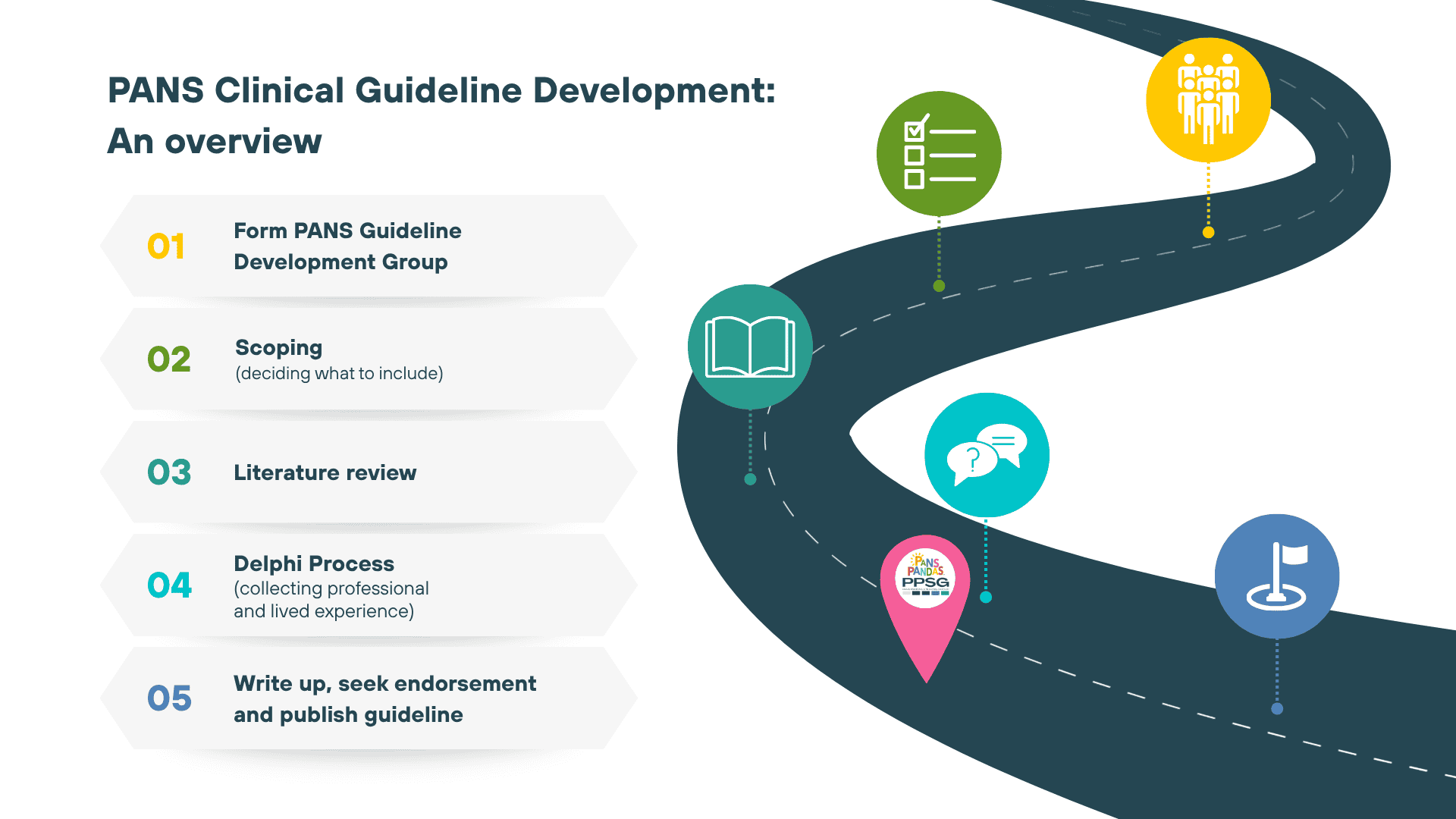
This diagram illustrates where we are on the journey of publishing a robust PANS guideline.